Rethinking the Close: Building Trust, Not Pressure
Aaron Arndt, PhD, Rhett Epler, PhD, Kenneth Evans PhD, and Sama Ashouri, PhD Candidate
Imagine taking several hours off from work to talk to a real estate agent about selling your house. After an hour-long conversation, the agent says, “My philosophy is that our first meeting should only be about getting to know each other. Next time, let’s discuss details about selling your house.” Would you be open to taking more time off from work to meet with this real estate agent again? Many sales “gurus” recommend that salespeople spend the first meeting building rapport and not try to close. However, customers might feel real estate agents are wasting their time if they do not “get to the point,” and closing is the point. Closings are moments in the sales interaction where customers formally acknowledge commitment to moving forward with the sales process, often with a contract or a verbal agreement.

Closing is often portrayed as aggressive and manipulative and more about the agent’s paycheck than building a healthy customer relationship. Yet, without closing, customer and client needs cannot be satisfied, and there can be no real relationship. We argue that closing is just as valuable for customers and clients as it is for real estate agents.
What Does Academic Research Say About Closing?
Until recently, closing has been conceptualized as a list of persuasive tactics—most commonly found in sales textbooks1,2—however, their origins and effectiveness are unclear. Textbooks expanded the list from the 1950’s (“minor point,” “assumptive” and “last chance” methods)3 to the 1970’s (“trial” and “direct” closes),4 and subsequent research has never established when—or whether—these tactics actually work.5,6,7,8,9 When Dr. Aaron Arndt (co-author of this paper) first taught professional selling in 2008, a student asked which tactic was best. After searching the literature, he found no real answers: past studies only collected salespeople’s opinions or used limited written scenarios that didn’t test real closing behavior.
Realizing there was no research on closing in actual sales interactions, our team set out to fill that gap—a process that ultimately led to our 2024 publication in the Journal of Personal Selling & Sales Management.
Off to a Rough Start
To better understand closing, we analyzed 111 real insurance sales videos and coded the closing tactics used. Our first attempt at consistent coding failed—trained raters simply couldn’t agree on which closing tactics were present. Even clear behaviors were labeled inconsistently, making the data unusable.
Years later, we tried again with a simpler goal: identify when a salesperson attempted to close. This time, raters agreed about 78% of the time. The issue wasn’t the raters or the manual—it was the tactics themselves. Many tactics overlap. For example, a “summary of benefits” close usually ends with a direct or indirect close, making it impossible to categorize cleanly. In reality, some tactics cannot occur without other specific tactics.
A Fresh Look
A clearer pattern emerged from the videos: closing unfolds in three phases—(1) a closing preamble that transitions into the close, (2) the closing moment when the salesperson seeks customer agreement, and (3) post-sale assurance, customer debriefing that follows. A summary of benefits is just one type of preamble; its purpose is to make the closing moment feel natural rather than abrupt—much like setting the stage before a marriage proposal. Imagine a young man intends to propose to his girlfriend. He takes her to a fancy restaurant, gets down on one knee, gets out the ring, and pops the question. By the time he is on his knees, his girlfriend should know what is coming and be prepared to answer. But what if he didn’t do any of that? What if, while walking down the cereal aisle in a grocery store, the boyfriend said, “Let’s grab a box of Cheerios. Also, let’s get married.” The proposal is so abrupt it might feel like an unimpressive joke.

We also observed that salespeople rarely end the interaction immediately after asking for the sale. Instead, they reassure the customer, recap next steps, or rebuild rapport—behaviors not covered in traditional closing tactics. With the proposal analogy, imagine how the girlfriend would feel if she agreed to get married and the boyfriend said, “Great. I will be in touch with the next steps later this week. Bye.” Post-sale assurance is an essential part of the close as it helps customers feel confident in their decision and preserves the relationship, even if they don’t buy immediately.
What do the Data Show?
We had additional raters code each preamble, closing moment, and post-sale assurance, and we then surveyed customers on rapport and purchase intention. Another group rated how approachable the salespeople and customers appeared. Overall, most salespeople simply provided information in the preamble and avoided clear closing questions, instead relying on subtle attempts to secure commitment. A few tried a trial close—an ill-fitting tactic for life insurance, which requires medical exams and ongoing payments. Of the 111 videos, only 43% resulted in a successful first closing attempt, and none of the trial closes worked.
Salespeople often needed multiple attempts to succeed: 68% ultimately closed, typically after two or three tries, with little benefit beyond the third. Remember the sales gurus who claim that the first meeting should only be about building rapport and that salespeople should not close in the first meeting? Our data shows otherwise. Customers who purchased reported higher commitment to their salesperson (mean = 5.40, where 1=strongly disagree and 7=strongly agree) than those whose salesperson only built rapport (mean = 5.11). In short, closing—not just rapport-building—strengthens customer relationships.
Closing 101 for Real Estate Agents
So, what about the student in Aaron’s class who asked which tactic to use? Well, 15 years later we finally have an answer. While life insurance is a very different industry than real estate, there are similarities, such as long sales meetings, a long sales cycle, and the importance of customer trust and commitment.
Our findings suggest three key recommendations for closing. Importantly, agents should view closing not as asking for money but rather as advancing the relationship. So first, plan to “close” in every meeting. Each meeting should have a clear purpose, with the close moving the customer to the next defined step—for example, securing a discovery meeting during prospecting or presenting a contract after discovery.
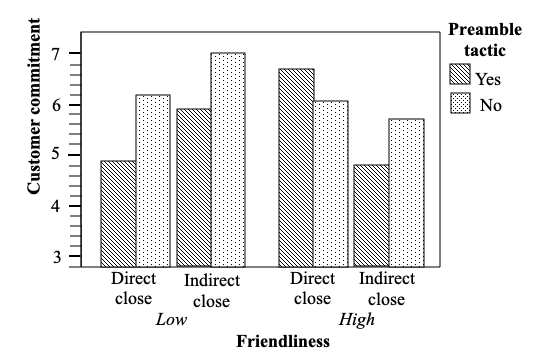
Second, friendliness can obscure the commercial purpose of the interaction. When customers are friendly, a brief preamble followed by a clear, direct close helps distinguish casual conversation from commitment. Friendliness does not equal willingness to move forward. Less friendly customers, however, already view the interaction as transactional; in these cases, skip the preamble and use an indirect close to avoid unnecessary resistance. Many agents in our sample defaulted to treating all customers as less friendly, but often the most effective approach was simply to ask directly whether the customer is ready to proceed.
Finally, and perhaps most importantly, do not rush out the door after the final close. Regardless of the outcome, spending a few minutes on post-sale assurance strengthens perceptions of empathy and responsiveness, ultimately increasing future commitment. Even when customers decline to proceed, this brief engagement can keep the relationship open—what is a “no” today may become a “yes” later.
As a final piece of advice, don’t be afraid of a “no.” A refusal simply indicates that the customer’s buying needs have not yet been fully addressed. This creates an opportunity to return to discovery, refine understanding, and try again. Closing is not the end of the sale but instead an important step in the customer-agent relationship.
. . . . . . . . . . . . . . . . . . .
Recommended Reading
Arndt, Aaron D., Rhett Epler, Kenneth Evans, and Sama Ashouri (2024), “Closing is More than a List of Tactics: How to Build Rapport While Facilitating a Commercial Exchange,” Journal of Personal Selling & Sales Management, 45(1), 45-63. https://doi.org/10.1080/08853134.2023.2300454
. . . . . . . . . . . . . . . . . . .
References
- Castleberry, Stephen B. and John. F. Tanner (2022), Selling: Building Partnerships, 11th edition, McGraw-Hill Higher Education.
- Johnston, Mark W. and Greg W. Marshall (2021), Contemporary Selling: Building Relationships, Creating Value,Routledge.
- Ivey, Paul Wesley and Walter Julius Horvath (1953), Successful Salesmanship, 3rd Edition, Prentice-Hall, Inc.: New York, NY.
- Pederson, Carlton and Milburn Wright (1971), Salesmanship: Principles and Methods, fifth edition, Richard D. Irwin, Inc.: Homewood, IL.
- Dubinsky, Alan J. (1981), “A Factor Analytic Study of The Personal Selling Process,” Journal of Personal Selling & Sales Management, 1(1), 26-33.
- Dubinsky, Alan J. and William Rudelius (1981), “Selling Techniques for Industrial Products and Services: Are They Different?” Journal of Personal Selling & Sales Management, 1(1), 65-75.
- Dubinsky, Alan J. and William A. Staples, (1982), “Sales Training: Salespeople's Preparedness and Managerial Implications,” Journal of Personal Selling & Sales Management, 2(1), 24-31.
- Hite, Robert E. and Joseph A. Bellizzi (1985), “Differences in the Importance of Selling Techniques Between Consumer and Industrial Salespeople,” Journal of Personal Selling & Sales Management, 5(2), 19-30.
- Hawes, Jon M. James T. Strong, and Bernard S. Winick (1996), “Do Closing Techniques Diminish Prospect Trust?” Industrial Marketing Management, 25(5), 349-360.
. . . . . . . . . . . . . . . . . . .
About the Authors
Aaron D. Arndt, PhD
Professor, Old Dominion University
Dr. Aaron Arndt (PhD – University of Oklahoma) has been at Old Dominion University since August 2008 and led the ODU sales program from 2019 to 2025 as the inaugural Chair of the Thurmond School of Professional Sales and Negotiations. His primary research interests are in personal selling, sales management, negotiations, and retailing. He has published 39 research articles to date in journals such as the Journal of Retailing, Journal of Personal Selling and Sales Management, and the International Journal of Research in Marketing. He has won multiple awards for his research and teaching, including the James M. Comer Award for Best Contribution to Selling and Sales Management Theory 2021. His research has been featured in the Virginian Pilot and National Public Radio.
Dr. Arndt teaches a variety of classes at the undergraduate and graduate level including professional selling, sales management, negotiation, marketing management, persuasion, and marketing research. He incorporates hands-on practice and community engagement projects into his classes so that students have the opportunity to develop skills and gain real-world experience. As part of his work in the Thurmond School, he has hosted dozens of outreach seminars to help people in the local community improve their negotiation and communication skills. He is also the Executive Director of the National Conference in Sales Management and the ODU faculty advisor for ODU chapter of Pi Sigma Epsilon.
Rhett Epler, PhD
Assistant Professor of Marketing, Old Dominion University
Dr. Rhett Epler (PhD – University of Wyoming) specializes in teaching professional selling, integrating innovative approaches such as AI-powered simulations and improv-comedy-based exercises, and researching topics including B2B sales, persuasion, and salesforce management. His primary research interests involve salesperson-customer interactions, incentives and technology implementation. Rhett has published research in Journal of Personal Selling and Sales Management, Industrial Marketing Management, Journal of the Academy of Marketing Science, Journal of International Marketing and Human Resource Management.
Kenneth Evans, PhD
University President, Oklahoma City University
Dr. Kenneth R. Evans (PhD – University of Colorado) has served as President of Oklahoma City University since 2021. Prior to that, he was the president of Lamar University in Beaumont, Texas, for eight years and dean of the Price College of Business at the University of Oklahoma for six years. Dr. Evans also served in a variety of administrative roles at the University of Missouri-Columbia and as a marketing professor at Arizona State University.
Even while serving in high level administrative positions, Dr. Evans is still an active researcher. His research has been widely published in top marketing and business academic journals, such as the Journal of Marketing, the Journal of the Academy of Marketing Science, the Journal of Business Research, the Journal of Personal Selling and Sales Management, the International Journal of Research in Marketing, and the Journal of Service Research to name a few. According to Google Scholar, his research has been cited more than 15 thousand times. Additionally, he has received national and international recognition for his contributions including the Lifetime Achievement Award from the American Marketing Association Sales Interest Group. He has spoken at conferences and universities around the world including in China, Taiwan, Finland, and Romania.
Before his academic career, Dr. Evans worked in the transportation industry in various marketing and sales capacities and has been involved in sales and sales management consulting in the banking industry, convention sales, and financial services.
Sama Ashouri, PhD Candidate
Visiting Lecturer in Marketing, Marist University, and PhD Candidate in Marketing, Old Dominion University
Sama Ashouri’s research explores how emerging technologies, artificial intelligence, and cultural dynamics shape online interactions and consumer decision-making. Her work bridges human–AI communication, mimicry, and trust in digital environments with applications in branding and marketing strategy. She has published in the Journal of Interactive Marketing, Journal of Business Research, and Journal of Personal Selling & Sales Management and has presented at major academic conferences such as the American Marketing Association Summer Conference and the Academy of Marketing Science.
Ms. Ashouri has taught undergraduate courses in Principles of Marketing, Marketing Research and Consumer Behavior at both Old Dominion University and Marist University, emphasizing experiential learning, ethical decision-making, and data-driven insight. Her teaching philosophy integrates theoretical rigor with hands-on applications to prepare students for modern marketing careers.
Before entering academia, she gained professional experience as a digital marketer, which continues to inform her applied research and classroom practice.
She is currently completing her PhD dissertation on the topic of mimicry behavior and personality alignment in AI-driven consumer–chatbot interactions. Her broader research interests include consumer-AI interactions, the role of empathy in consumer behavior, online gaming experiences, and influencer marketing.
. . . . . . . . . . . . . . . . . . .
Download this Article
KCRR 2026 March - Rethinking the Close-Building Trust Not Pressure (Arndt)